Built by an insulation contractor

The spray foam and insulation estimating app, built in a Tennessee attic

Nine out of ten of my estimates go out without a site visit. The customer emails or calls, I ask three questions, and the priced estimate is in their inbox in about a minute. Here is how that works, a calculator that does the math on your own rates, and the app that writes the estimate while you are still on the phone.

How I quote 90% of my jobs

A customer asks "how much?" I ask three things back, and I can price almost anything from the answers.

1. What am I spraying to? Walls, roof deck, attic floor, crawl space walls, or the whole shell.
2. What are the dimensions? Length by width, wall height, and the roof pitch. "20 by 40, 8 foot walls, 4/12" is enough.
3. Is there a moisture barrier? That one decides open cell or closed cell, and the depth, and so the price.

Then I say it into my phone: "20 by 40 shop, 8 foot walls, 4/12 roof, closed cell 2 inches on the walls and roof deck, no barrier." The app builds the lines with the square feet, the depth, and the board feet showing, in my rates, and it is sent before the call is over. For the jobs worth the drive I book the visit, because I close higher in person, and the customer can ask me to come look right from the estimate.

Spray foam calculator

Put in the building and your rates. It figures the surface area from the dimensions and the pitch, turns it into board feet at the depth you choose, and prices it. Every rate is an example until you change it.

Dimensions to board feet to price

Gable roof with the ridge along the length. For a flat ceiling or an attic floor, tick that box instead of the roof deck.

The math

Walls0 sq ft
Roof deck0 sq ft
Gable ends0 sq ft
Attic floor or ceiling0 sq ft
Crawl space walls0 sq ft
Surface to spray0 sq ft
Board feet at 2 inches0
Foam, installed$0
Setup and travel$0
Estimate$0
Deposit at signing$0

Example rates. Your material cost per set, your rig's yield, and your crew day set the real number. Put your rates in SayEstimate and say the next one into your phone.

The worked example: a 20x40 shop, 8 foot walls, 4/12, no barrier

The three answers above, priced the way the app prices it. Closed cell because there is no barrier, 2 inches on the walls, the roof deck, and the gables. The rates are examples; mine are mine and yours are yours.

Line itemQtyRateAmount
Closed cell spray foam, 2 inches, exterior walls2 x (40 + 20) x 8 = 960 sq ft, 1,920 board feet1,920 bf$1.35$2,592
Closed cell spray foam, 2 inches, roof deck40 x 20 x 1.054 slope = 843 sq ft, 1,687 board feet1,687 bf$1.35$2,277
Closed cell spray foam, 2 inches, gable endsTwo triangles, 67 sq ft, 133 board feet133 bf$1.35$180
Setup, masking, and travelRig, plastic, and the drive.1$250$250
Estimate total$5,299
Deposit at signing (30%)$1,590

That is 1,870 square feet of surface, 3,740 board feet, and the customer can see all of it. If they want me to look before they decide, the estimate has a button for that, and I book the visit from my phone.

What belongs on a spray foam estimate

  1. What is being sprayed, by surfaceWalls, roof deck, gables, attic floor, crawl walls, each its own line. One lump number hides the math and invites a lowball comparison.
  2. Square feet, depth, and board feet on every foam lineThe customer sees the quantity, and you have the number that matches what the rig will use.
  3. Cell type and whyClosed cell, no barrier, vapor retarder. Open cell, conditioned wall, cheaper per inch of R-value. Say it in a sentence; it is the difference between you and the cheaper quote.
  4. R-value at the depthClosed cell runs about R-6 to R-7 per inch, open cell about R-3.5 to R-4 per inch. Print the R-value the depth gives, because the inspector and the customer both ask.
  5. Prep, masking, and removalOld insulation out, plastic on the windows and the floor, ignition barrier or thermal barrier if the code calls for it. Their own lines.
  6. Setup, travel, and minimum jobThe rig costs money to roll whether the job is 400 board feet or 4,000. Print the minimum.
  7. Access and conditionsCrawl space clearance, attic access, temperature. Foam does not like a cold substrate; say what happens if the weather does not cooperate.
  8. Deposit, balance, and what is not includedDeposit at signing on anything with a rig day committed. Not included: drywall, electrical, HVAC, and moving what is stored in the attic.
Questions insulation contractors ask

How do you quote spray foam without seeing the job?
Three questions. What am I spraying to (walls, roof deck, attic floor, crawl space walls)? What are the dimensions (length by width, wall height, roof pitch)? Is there a moisture barrier? Those three give you the square footage, the cell type, and the depth, and that is a price. Nine out of ten estimates go out from a text or an email with those answers in it. The visit is for the jobs worth the drive, and the visit closes higher.
Open cell or closed cell?
The practical rule: no moisture barrier, closed cell, because it is a vapor retarder at about 2 inches and it adds rigidity to metal buildings. Existing barrier or a conditioned interior wall, open cell, because it is cheaper per inch of R-value and fills irregular cavities better. Roof decks and crawl space walls usually get closed cell. Attic floors over a sealed ceiling usually get open cell or blown. Your climate zone and the inspector get the final say.
What is a board foot of spray foam?
One square foot at one inch deep. Multiply the square feet by the depth in inches and you have board feet; that is how foam is priced and how the kits and the rig are measured. A 20x40 shop with 8 foot walls and a 4/12 roof is about 1,870 square feet of surface; at 2 inches of closed cell that is about 3,740 board feet.
How much does spray foam cost per square foot?
It depends on the cell type, the depth, the access, and your market, so the honest answer is a range that you set from your own material cost per set, your rig's yield, and your crew day. The calculator on this page runs on your rates. What matters more than the number is that the estimate shows the square feet, the depth, and the board feet, so the customer can see what they are paying for.
Do I need a moisture barrier before spray foam?
Closed cell foam at 2 inches or more is its own vapor retarder in most assemblies, which is why it is the default where there is no barrier. Open cell is vapor permeable and wants a barrier or a conditioned space behind it. This is the question that decides the cell type, so it is the third thing to ask.
What is the best insulation estimating app?
The one that takes the three answers and turns them into a priced, line-itemed estimate before the customer hangs up. SayEstimate was built by an insulation contractor for exactly that: say the job, the AI drafts the lines in your rates with square feet, depth, and board feet showing, the customer signs on their phone, and if you want to see the job first, they can ask you to come look right from the estimate. $9.99 a month, no per-seat fees, 14-day free trial, no card.

How SayEstimate writes an insulation estimate

Everything below is included. No modules, no add-on pricing, no sales calls.

🎤

Say the three answers, it prices it

"20 by 40, 8 foot walls, 4/12, closed cell 2 inches on the walls and roof deck." The AI drafts the lines in your rates with square feet, depth, and board feet showing. About 60 seconds, start to send.

🏠

They can ask you to come look

Right on the estimate: "Want them to come take a look first?" One tap, you get an email, and Book the visit is on the row. Virtual quote, in-person close.

🥇

Batts, blown, foam tiers

One description, three priced options. The homeowner picks their comfort level instead of choosing whether.

✍️

Signed and deposit paid on the phone

The customer signs and pays the deposit by card or bank in the same tap. You are emailed the moment it happens.

📣

Your own lead page asks the three questions

The Instant Quote page asks for the size up front: length by width, wall height, pitch, barrier. The lead lands with the math already in it.

💵

Paid, and the books agree

One tap from estimate to invoice. Cash and check marked paid with how they paid. Card and bank settle to your own account with 0% markup.

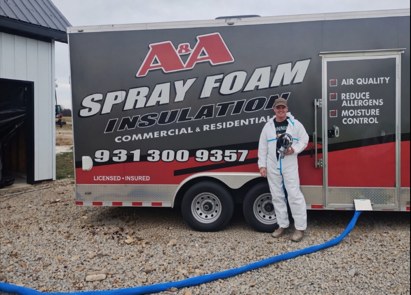
Terry Hoss Tenison beside his spray foam trailer in Lawrenceburg, Tennessee

Written by Terry "Hoss" Tenison sprays foam and blows insulation for a living in Lawrenceburg, Tennessee, and built SayEstimate because nothing out there quoted a job the way he actually quotes one. This page is his trade and his workflow; the example rates are illustrations, and your market sets the real ones. More about Hoss →

Keep going

Work out your real crew hourly rate, read how much deposit to collect, or grab the free estimate template. Related trades: Waterproofing · Drywall · HVAC · all 38 trades.

Price the next one before they hang up

14 days free · No credit card to start · From $9.99/mo after · Cancel anytime

Start free. 14 days